Imagine this: you’re a die-hard football fan, and then the Russian Football Union, together with Fonbet, goes and changes the Cup format. Suddenly there are two parallel tournaments — the “Path of the Regions” and the “Path of the Champions.” Even pundits were scratching their heads trying to figure out the new bracket. But for regular viewers, the challenge wasn’t just to understand the system — it was to fall in love with it.
That’s when they came to us with a task: create a game that would serve as a fan’s navigator through the Cup for the entire season. Something a person would open once, and then come back to every day — tracking the stages and rooting for their virtual team just as fiercely as they do for their real one. We proposed a Telegram Mini App where every user gets their own football club to manage. You log in via Telegram, come up with a team name, pick a logo, name your players, and hit the tournament bracket.
The project ran for a full year and built a steady audience: over 2,000 people on weekdays, soaring to 15,000 on peak days. And 81% of sessions didn’t end in a quick bounce — they led to real immersion in the gameplay. Most importantly for the client, one in three players completed a target action with Fonbet. And it never felt like pushy advertising; people genuinely wanted to earn bonuses to level up their club.
Why a game was needed at all
The new Russian Cup format is a cool thing, but it’s unfamiliar. Instead of a single clear-cut bracket, two paths; instead of a couple of matches, a long tournament marathon. We thought: why not turn that marathon into an interactive experience? Let the fan, in parallel with real-life football, guide their own club through the same bracket — making decisions, training players, and ultimately reaching the super final. That’s how the idea of a strategy game with manager sim elements was born — only lightweight, mobile, and designed for daily logins.
The team faced ambitious goals:
-
Transform the brain-twisting Cup scheme into an intuitive gameplay loop;
-
Maintain interest over a 9–10 month stretch;
-
Integrate Fonbet so seamlessly that players would actively want to engage with the brand;
-
Build a community around the game that would discuss both real matches and their own in-game successes.
How it all began: the birth of a club and first steps
At first login, we didn’t throw players straight into the deep end of mechanics. First came the fun part: name your club, pick from a dozen original logos (no copying real teams to avoid confusion), and give your players names. You could generate them randomly, or type in your friends’ names. After onboarding, the player landed on the main screen — their own training base, drawn in a pleasant vector isometric style. At first it’s empty, just a couple of buildings. But over time, as you earned budget, you could upgrade your office, pitch, gym — and the base grew before your eyes, visually rewarding your progress.
Mechanics that kept them coming back
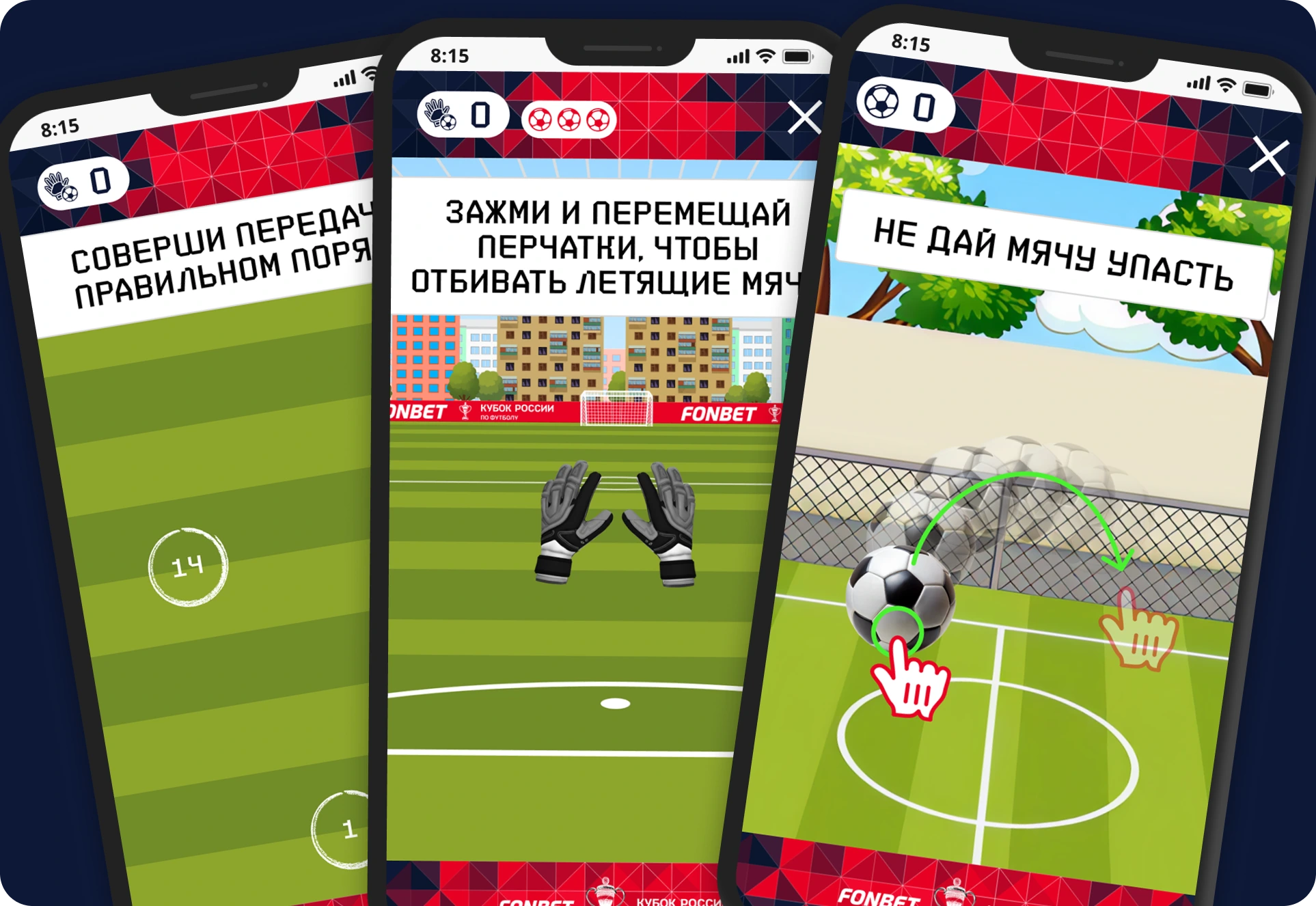
Three mini-games instead of boring drills. To raise your team’s “Class” (the main power parameter), you had to train. We created three arcade-style games, each available once per day:
-
Keepy-uppy — tap the screen, don’t let the ball drop, every touch changes its trajectory;
-
Goalkeeper — deflect shots flying at the goal from different directions;
-
Passing drill — memorize a sequence of passes and repeat it.
Simple, yet addictive. And most importantly, training gave a steady boost to your stats, giving you a reason to log in every day.
A Reigns-style card game in a football setting
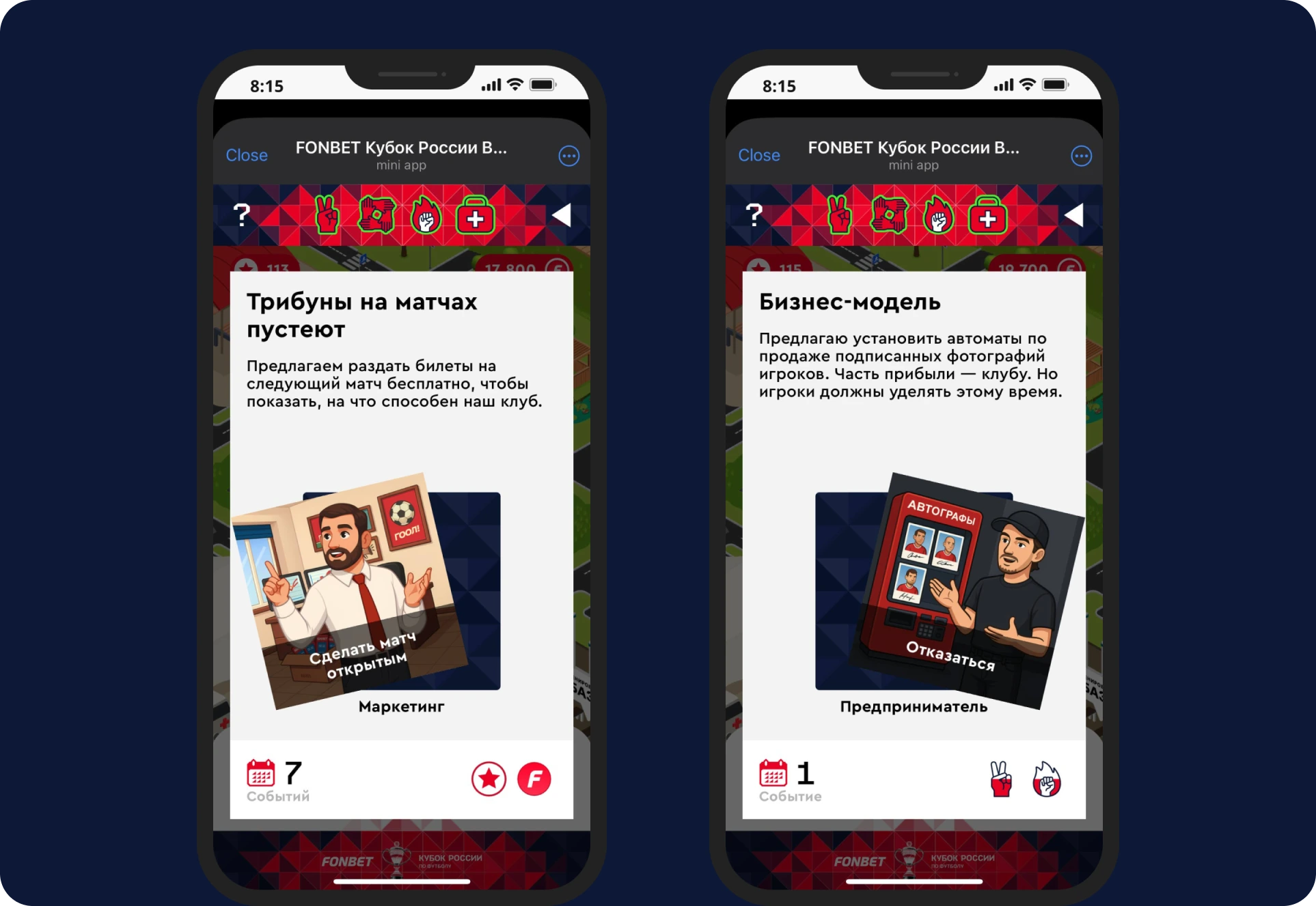
The heart of the game: events. Every day the player received 5 cards with situations from club life. A farmer demands rent for the pitch paid in potatoes, fans have brought smoke bombs and threaten to defect to another club, your star player has fallen out with the coach! You have to decide — swipe left or right. And you never know what the outcome will be: it might boost motivation but hit your budget, or the reverse. We wrote over 400 of these situations, many with humor and nods to real football lore. It created the feel of a living world where your club leads its own unpredictable life.
Matches tied to the real-life calendar
Once a week, a new Cup stage opened — on the exact same dates as in real life. The player had to field their team against a bracket opponent. Victory was awarded automatically if their club’s “Class” exceeded a threshold. If not, they could train more, spend budget on a boost, or complete extra tasks.
Economy and conversion: how we tied the game to Fonbet
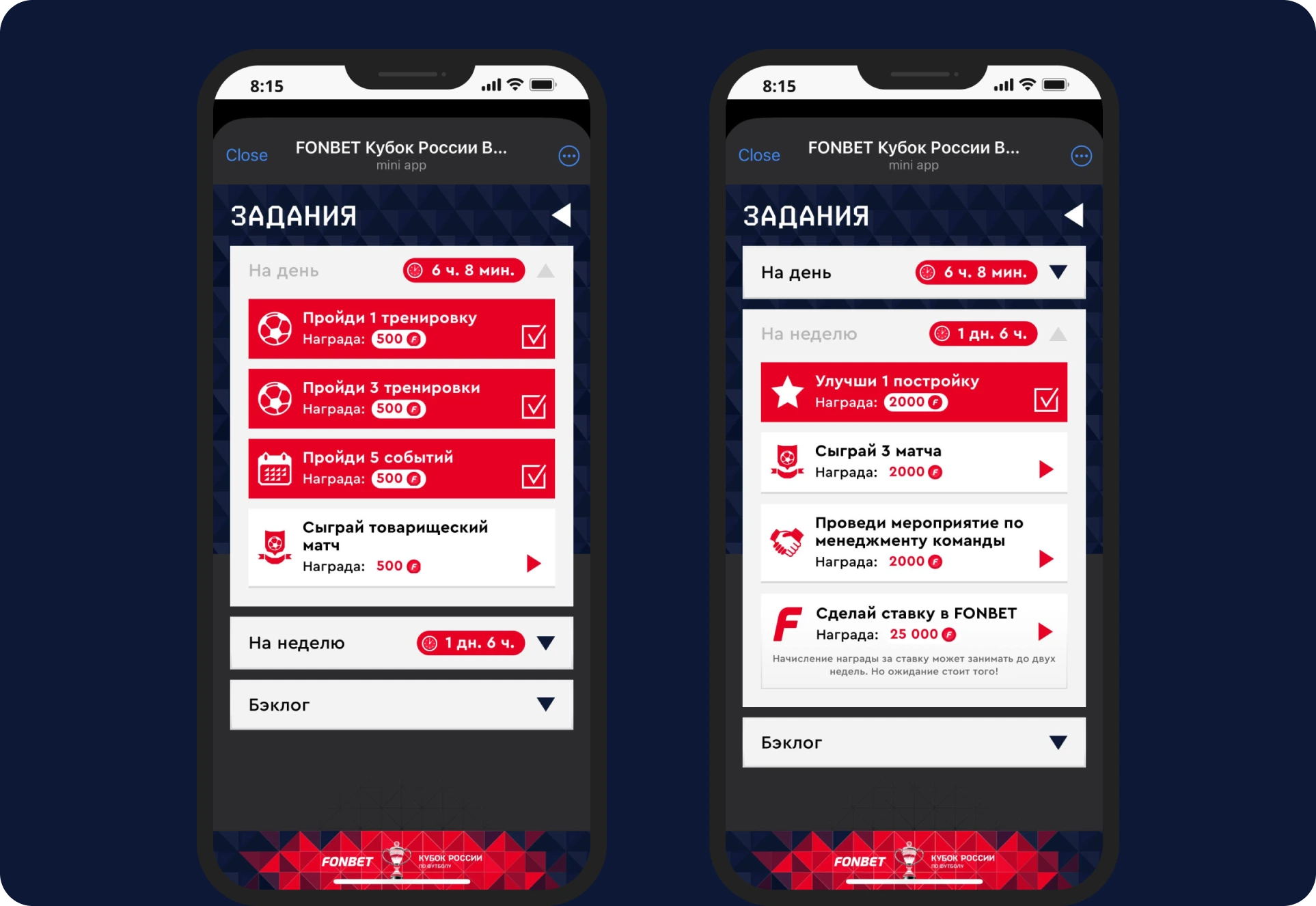
Your club’s budget was earned by completing tasks. We made three types:
-
Daily (train, go through events) — to bring players back every day;
-
Weekly (place a bet with Fonbet) — to align with the tournament rhythm;
-
One-time (subscribe to the Fonbet Telegram channel or the Russian Cup channel, become a Fonbet customer) — the main conversion points.
Tasks gave in-game currency, which could be spent on upgrading your base. And an upgraded base, in turn, increased the stat boosts from training and unlocked new events. A closed loop where every conversion action sped up progress. The additional events mechanic worked especially well. When a player ran out of their daily 5 cards, we showed a screen: “Want more? Subscribe to the Fonbet Telegram channel and get +3 events forever!” For many, that was the trigger — because events were the most engaging content, that’s where the real life of the club unfolded.
Monthly contests and the grand prize
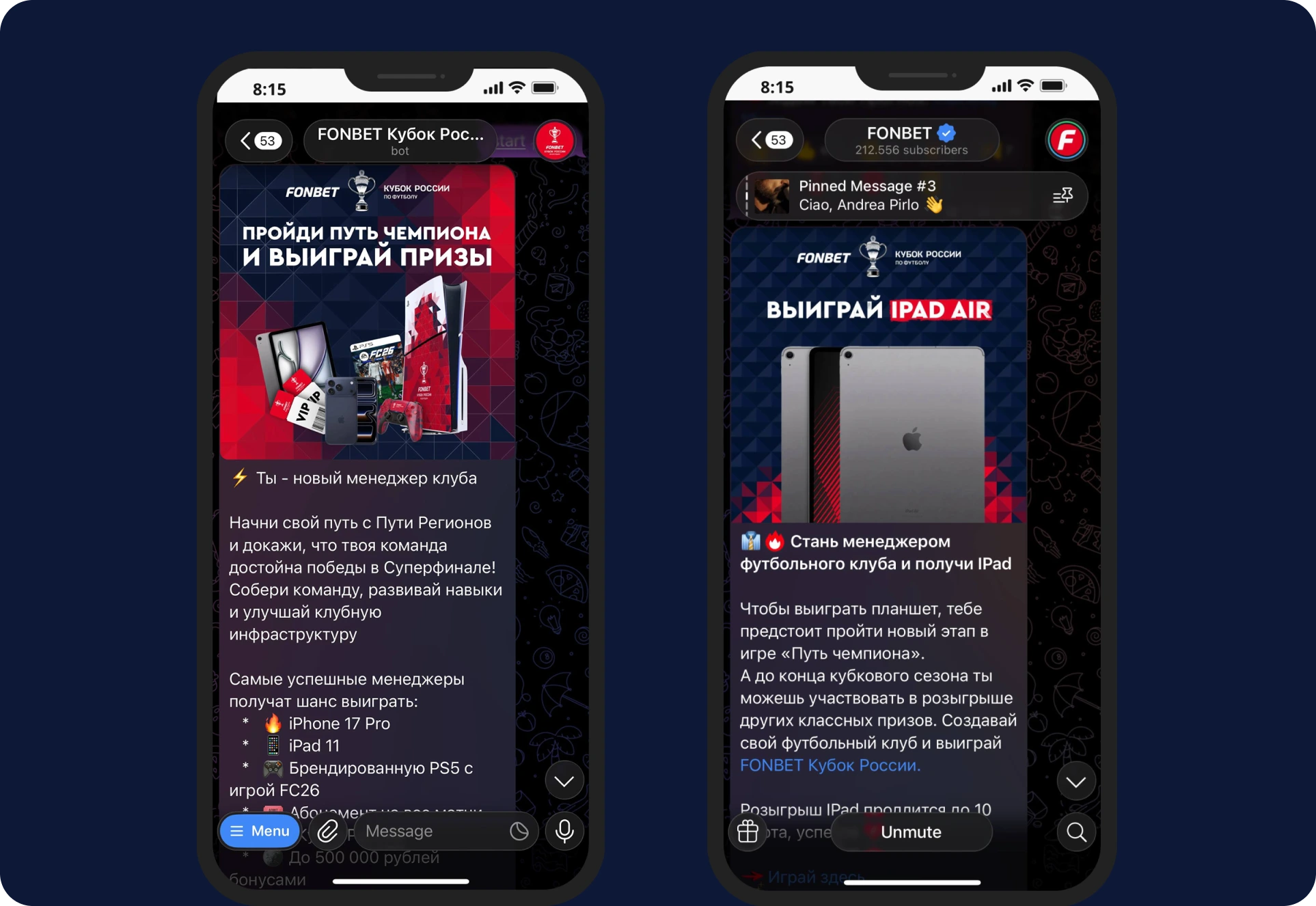
To keep momentum, we ran monthly giveaways. The condition: reach a certain Cup stage in the game and complete a conversion action. Prizes included merch, gear, match tickets, and valuable gifts like new iPhones or a PlayStation 5. And at the end of the season, we gave away the grand prize — a trip to the Russian Cup super final. This created a magnetic pull: people knew that if they made it to the end in the game, they’d have a shot at attending the real final.
What came of it all
We didn’t just build a game — we built a daily ritual for thousands of fans. Over the course of the year, the audience held steady at 2,000+ people a day, and during peak moments (like just before the final) online numbers soared to 15,000. A 19% bounce rate meant 8 out of 10 people who opened the app stayed and started playing. And most importantly — 33% of players completed a direct conversion action with Fonbet. The best part: this wasn’t a hardcore football game for die-hard fans only. The mechanics proved intuitive even for those far from sports, and the humorous card system pulled them in.
We proved that complex changes in tournament formats can be explained not through articles and infographics, but through a living product you want to return to. And when real teams walked onto the pitch, thousands rooted for them not just as spectators, but as colleagues — because their own virtual clubs had walked the very same path.